To receive email notification

Please fill the contact form below to receive email notification when a new post is published in this blogspot.

Wednesday, 14 July 2021

Yazidis - From the roots of ancient Tamils!!

Yazidis / Yezidi - From the roots of ancient Tamils!! 


        Yazidis / Yezidis are ancient Kurdish ethnic religious group, who predominantly lives in Northern Iraq, near Sinjar Mountains where their holy site is situated. They have also scattered across Turkey, Iran, Syria and in European nations. 

 Yazidis are being ethnically cleansed, as they are non muslims! Yazidi's do not know their own history and about their homeland!!

        Actually, Yazidi / Yezidis are Hindus from ancient Tamizhakam, who were then migrated to Afghanistan, Iran, Iraq, Syria, Turkey and across middle east countries before 5000 years. The Yezidi calendar is around 6800 years old and is the oldest calendar in the Middle East countries. They don't know about their roots that they were Hindus, who originally hailed from the land of Tamils. 


        In this blog post, I will disclose about the roots of yazidis, their homeland in detail with appropriate references. First, let us see about Yazidi's religion and their traditions which is similar to that of Hinduism....

Yazidis and Hindus:

        As Yazidis are from Hindu community, they follow many hindu traditions and rituals. According to the oral history of Yazidis, several thousand years before, they lived in India, Perani was their holy place. Then, later they migrated to Persia via Persian gulf. They also believe in the concept of Karma and rebirth, like in Hinduism. 

Check the below picture of Yazidis temple at Lalish in Iraq. Their temple is looking similar to a Hindu temple.


        Yazidi's religion has many elements which are similar to Hindu rituals. Also, within their religious framework they preserved some of the very ancient beliefs that is no longer surviving in any other religion. Yazidi's religion can be traced back to ancient Mesopotamia religion.

Below picture: Yazidi's priest performing a homam / yagna with fire, like Hindus...


Yazidi women lighting a fire (Arti ritual in Hinduism) and worshiping their god...


Yazidi priest applying Tilak on the forehead, like Hindus...

        
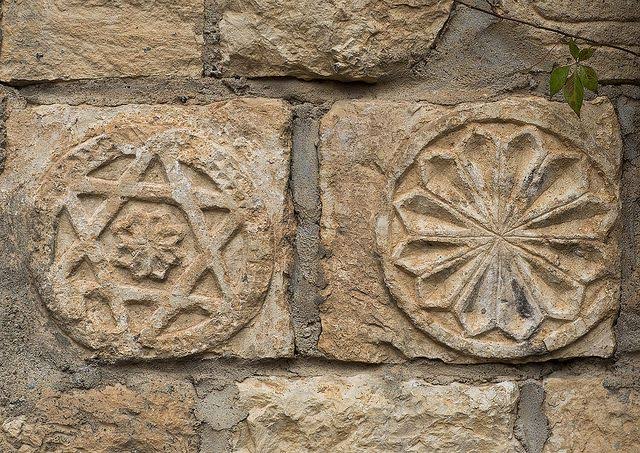
Hindu symbols like star and flower carved in Yazidi's temple...


This is a six pointed star, which is a symbol of Lord Murugan / Karthikeya in Hinduism...

        As Yazidis are hindus and following hinduism, they are forced to convert to Islam. ISIS declared that Yazidis are Satan worshipers. 

In August 2014, the Yazidis became victims of a genocide by the Islamic State of Iraq and the Levant in its campaign to eradicate non-Islamic influences.  The reason that ISIS attacks the Yazidi community in this way is because they view them as pagan and polytheistic because they’re outside of the Abrahamic religions that's having a written scripture.


        The genocide led to the expulsion, flight and effective exile of the Yazidis from their ancestral lands in Upper Mesopotamia. Thousands of Yazidi women and girls were forced into sexual slavery by the Islamic State, and thousands of Yazidi men were killed.

   
        Thousands of Yazidis died without food or water. People were too weak to flee from the mountains of sinjar and millions of Yazidis had died when ISIS entered their mountains. They gunned down thousands and thousands of Yazidis. 210,000 died in all. Women were raped and sold in the marketplace for as little as US $10. Swords and knifes were used to decapitate the Yazidi men who had been captured. Most refused to convert to Islam and rather preferred to be beheaded.

500,000 Yezidis are now refugees in Syria.


        Joanna Palani, a brave daughter of Iranian Kurds had fought for kurds against ISIS, on the front line of Syria in 2016. Her surname 'Palani' indicates that she belongs to 'Palani' tribe of Kurds.

'Palani' tribe is one of the most powerful kurdish tribe in Iraq.  

Who are Kurds? 
Why this group of kurds are called as 'Palani' ??? 
What is the meaning of palani?

How Yazidis are connected with Tamil people ? 

Continue to read, to know answers for all these questions...

Quote from Wikipedia, 
"The Yazidi religion is monotheistic and has roots in a western pre-Zoroastrian Iranic faith."

Note the word, Pre Zoroastrian. 

        Zoroastrianism - is often compared with Vedic civilisation and there are many similarities between these two. So, Pre Zoroastrian means - pre Vedic civilisation.

What is Pre Vedic civilisation ???

Pre Vedic is none other than 'The ancient Tamizh / tamil civilisation'. This post will uncover the connection between Yazidis and ancient tamils, with appropriate references.... Tamil civilisation existed before the start of Vedic civilisation. Also, Tamil civilisation had laid foundation for the Vedic civilisation, if you want to trace the true origin / history of Akand Bharat, then have to look beyond vedic civilisation, to know the true age of civilised Bharat. When the roots of vedic civilisation is traced, then one can see an acclaimed buried truths of one huge pre-vedic civilisation!!

For more information regarding pre-vedic civilisation, reach out below series...


Now, coming back to the topic of Yazidis, Yazidis worship a peacock angel called 'Melek Taus', an emanation of God and good. So, Yazidis were called as the children of Melek Taus.

        Symbol of peacock was used in many places in Persia and by the Persian kings. It has a special and unique place in their kingdom. Also, peacock imagery adorns Yazidi shrines, temples, their gateways, graves, and their houses of worship. 

        But, Peacock is not indigenous to middle east countries like Iran, Iraq, Turkey, Armenia and Syria, instead peacock is indigenous in India. So how come peacock was famous over there and why did they engrave peacock images everywhere in their temples and worshiping it?

HERE STARTS THE CONNECTION OF YAZIDIS WITH TAMILS....

Peacocks exist only in India.

             Melek or Malik is an ancient Semite god of Babel and Canaan. Melek or Malik is derived from the ancient Tamil word Malaikavon, which is another name for Lord Murugan.

Below is the picture of the multi-armed Yazidi god. Multi armed god idols exist only in Hinduism. The peacock image in the background and the snake representing Kundalini is their version of Lord Murugan. Lord Murugan is much revered god in South India, especially in Tamil Nadu.


Actually, The GOD of the Yazidi's is son of Lord Shiva and Parvati, i.e Lord Murugan ( Kartikeya/ Subramanya ). Kartikeya's elder brother is Lord Ganesha.

Peacock is the vahana of Lord Muruga, thats why peacock is being worshiped by Yazidis and peacock motifs are popularly used in many Persian designs, palaces and Yazidis temples.

Yazidi's symbol is a lamp with a peacock on it's top. 

Yazidis use oil lamps for worshiping, which has peacock on the top. This is similar to the custom followed in Tamil nadu and the peacock lamp is called as 'Mayil vilaku' in tamizh.


Oil lamp in yazidi temple... Women are lighting these lamps in their temple...


Below picture is the temple of Yazidis, which is situated in Iraq. Yazidi children are playing in their temple...


    Look at the temple of yazidis at Lalish in the above picture. The women in saree, the style of saree draping, the hair style of women with flowers and she lighting their holy peacock lamp, isn't she resembling like a Tamil women? 

Check the picture below, a south indian women is lighting a peacock lamp in India...


It is indeed proving that yazidis are hindus and they are originally from the land of ancient Tamizhakam.

        In fact Yazidis are Hindu brahmins who were priests at Gobekli tepe and many hindu temples in Turkey, Iran, Iraq and Syria....

        These points that, Yazidis worshiping Lord Murgan and peacock are NOT the only references for Tamil connection and ancient tamizhakam. It is just a preface.

I have explained in detail with many references and sub references to prove that Yazidis were rooted from ancient tamils. Please read this post completely, to know more strong and supporting points for the same....

References for Yazidis and Tamils connection

        The ancient and earliest people in Persia were tamizh people and to be precise they were dravidians, who were migrated from tamizhakam.  Yazidis worshiped tamizh deity Lord Murugan and named many places in Persia after him. Murugan's symbols such as six pointed star, peacock and snake were also engraved in their temples and worshiped by yazidis...

        In Tamil, Lord Murugan is also called as Kandhan, Kumaran, Saravanan. There are places in Persia, which are named after tamil names of Lord Murugan. Why was it named in tamizh?

Example: A place called 'Saravan' in Gilan province of Iran. 

Tamil names of Lord murugan was used to name places in Persia. Example: Check the below picture for the places that are named in tamil in Turkey... 


All these are proper Tamil names of Lord Murugan. If the early persians / yazidis weren't tamils, then why did they name these many places in Persia in Tamil???

Couldn't believe that Yazidi's are Tamils... Then, lets know the answer through the below questions,

1. Who are Kurds?

        One can ask any Iranian or persian people regarding the origin of the name Kurds. No one knows it, because, it is derived from tamizh language....

To know the truth, one needs to look through Tamil...

            Lord Murugan married his consort Valli, Valli is the second consort of kartikeya and she belongs to a forest people group called Kuravar. Kuravars are tamizh tribes of Kurunji region (mountain region).

These kuravars / Kurunji people were migrated to Persia, resided in persian mountains and hence called as 'KURDS'.

According to tamizh sangam literature, landscapes were classified into five divisions.
  • Kurinji landscape - the hilly region, 
  • Mullai landscape - the forest land, 
  • Marudam / Marutham landscape - the cultivable land
  • Neidal / Neytal landscape - the sea-shore, associated with pining. 
  • Palai landscape - desert, associated with separation.

            In Iran, there are places called 'kurinji' and 'Neytal', which exactly matches with the type of landscapes mentioned in the tamil sangam literature. 

Naming places in tamil in Persia, that too naming it according to the Sangam landscape divisions, doesn't it look suspicious?

        As Tamizh kurunji people had migrated and lived in the mountain regions of Persia, they were called as Kurds. 

Let us see about more references, to support this point

        1.1. Northern Kurdish group is called as Kurmanji. Isn't it similar to Kurunji, a tamil landscape????

        1.2 Southern Kurdish group live in Ilam, Lorestan etc.. I have already published a post called, 'Kumari kandam - Part 6 (Elam civilisation of Iran)'. This post explains in detail with proofs that ancient Ilam people in Iran were Tamizhs. For more information about it, reach out to,


Yazidi people were one of the kurinji people, so they inhabited near Caucasus mountains and Sinjar mountains. Yezidis were originally known as 'Ezidi', which is derived from Elam in tamizh....

2. Why did the Yazidis worship Lord Murugan specifically?

 As per tamil sangam literature, each landscape is associated with a particular deity to worship. 

Kurunji Landscape - mountain region - associated with - Kottravai and Murugan deity. 

        So, as per the sangam literature, Kurunji people worshiped Kottravai and Murugan Gods. Murugan is considered as God of hill people and so they named many places after him in Persia. Valli is Lord Murugan's second consort.

'Vali' - is name of a village in Khuzestan Province of Iran. 

There is also a place in Iran named as 'Kurinji'.

Valian - also known as Velian is a village in Alborz ProvinceIran. For more information about tamil civilisation in Iran, reach out to, 

https://divinediyaas.blogspot.com/2021/03/tamizh-kings-and-culture-in-ancient.html

https://divinediyaas.blogspot.com/2021/03/tamizh-kings-and-culture-in-ancient-Iran-part2.html

https://divinediyaas.blogspot.com/2021/03/tamizh-kings-and-culture-in-Iran-Part%203.html

           As Yazidis were kurunji people, they resided in Sinjar mountains in Iraq and their holy site is also located in that mountain. They worshiped Tamil god Murugan and his symbols as well, such as peacock and snakes at their temples.... 

Check the picture below for reference. Yazidis temple with snake at the side wall. 


         The common motif - peacock of Yazidis and Murugan are symmetrically disposed on both the sides - a feature taken from Persia which denotes the psychic duality of man drawing its life force from the principle of unity.


3. Why a group of kurds tribe are called as 'Palani'?

Palani / Pazhani is a holy place of Hindus in Tamil nadu, where a famous temple of Lord Kartikeya / Muruga is situated on the Pazhani hills. This hill and the whole city is called as 'Pazhani', it is pronounced using retroflex tamizh letter 'zh' (like 'zh' in Tamizh). 


        This place was named after Lord Murugan by the poet Auvaiyar when she praised Murugan as 'Gnana Pazhani appa'.  'Gnana' - means knowledge, 'Pazham' - means fruit  + 'Ne' - means you -  together as knowledge fruit,  poet Auvaiyar praised lord Murgan as a 'well knowledged person'.

        This Pazhani temple is the Mecca for Yazidis... In the mythology of Yazidis, they call their holy land as 'Perani', which is none other than 'Palani'. As they can not pronounce the letter 'Zh', they are calling it as 'Perani'. Now, you got to know, why those kurds tribe were called as 'Palani'?? and retroflex letter 'Zh' used in 'Yazidi'.

        Pazhani is one of the ancient temple in Tamil Nadu and is famous for the ancient 'Navapashanam' idol of Lord Murugan. 

Navapaashanam - means nine poisonous minerals. This idol of Lord murugan was made of nine poisonous minerals by a great Siddhar Bhogar. He was expert in metallurgy and he made Shiva lingams using palladium group of metals infused in mercury. The amalgamation of the navapashanam was prepared through a secret process and it is considered as 'elixir of mankind'.


    Abhishekam - meaning bathing of deities. The water used to bath this Navapaashanam idol of Lord Murugan is called as 'Elixir of life'. This holy water has numerous medicinal values and cures many incurable diseases, it gives strength and energy to the people who consumes it.

  How did the Siddhars convert a poison into healing elixir of life ??

        Ancient Siddhars of tamizhakam had a great knowledge of converting inorganic substances into a nano and ionic form which is easily absorbed by the human cells. Mercury, is widely used in Siddha medicines. Mercury, a killer poison, is converted into healing nectar, when properly purified and processed. 

        Navapashanam was not made due to sheer human brilliance, a true wisdom of knowledge was gained from the universe (God) , which helped siddhars to make Navabhashanam. Siddhar means - one who attained spiritual perfection / consciousness and the power to control the physical realm.

Navapashanam contains “high positive energy”. It also acts as a catalyst to awaken ones self.

Maharshi Agastiyar / Agastya was the first one to solidify mercury through the use of herbs. Siddhars converted a silver into Gold, by a single touch, they were mastered in Asta siddhis. The Siddhars also consumed purified mercury, Iridium, Rhodium and gold in order to achieve physical immortality.

Many great Siddhars resided and did penance in the hills of this pazhani temple. Some local people are believes that even today there are few Siddhars, who are invisibly residing in this Pazhani hills....

     For Yazidis, Pazhani temple of Lord Kartikeya in Tamil nadu is like a Kula deviam (Family god), so yazidis worship him without fail through his symbols. Now, one can see why there are so many peacock motifs in Persia and Yazidi's temples!!


        The history of Yazidis, their religion, their ancestral roots from tamizhakam, the naming convention of kurds, their holy place, tribal name of kurds and their rituals are proving that Yazidis are none other than Tamil hindus, who worships Lord Murugan. Several thousand years before, they migrated from ancient tamizhakam and still following the culture though they face huge oppositions and suppressions...

        As Yazidis are non muslims, ethnic cleansing of yazidis were carried out by ISIS and killed millions of them in the last few decades. When your identity is lost, roots are lost, history is lost, then no one will notice you / save you and ethnic people's life will be in danger!! Only God can help them...

        Thus, our Roots, our History and our Identity is important to be alive forever, to save our next generation people!! So, let us spread and pass on the information about our ancient history, glory, knowledge, our identity of our ancestors to next generations and will keep our roots alive, more safer and stronger!!!

- Aarthi Thiyagarajan

Wednesday, 7 July 2021

Oldest Lord Shiva temple in the World !!

Oldest Lord Shiva temple in the World!! - Uthirakosamangai temple

Uthirakosamangai temple in Tamil Nadu, is the oldest shiva temple in the world !!

    This temple existed even before the period of Ramayana - Treta yuga (second yuga in yuga cycle). Mandothari (Wife of Ravana) worshiped Lord Shiva here, before marrying Ravana. This temple is around 8000 years old, built by early Pandya kings of ancient Tamizhakam.

 Uthirakosamangai place is a religious capital center of Pandya kings and it is also mentioned in tamil sangam texts....


Uthirakosamangai is a tiny hamlet in Ramanathapuram district of Tamil nadu. It is a pre-historic place, and it is the most ancient place in the World, scholars refer this place using an idiom that 'Did the mud come first or the Mangai (Parvati devi)?' - meaning, uthirakosa mangai exist before the creation of mud in this world. In tamizh, the idiom is, 'Mann mundhiyo, mangai mundhiyo'?

Here Lord Shiva is called as 'Mangalanathar' and Parvathi devi as Mangaleshwari. This temple is also called as 'Mangalanathaswamy temple' and it is considered as the First shiva temple in the world. 

In a rare phenomenon, Lord shiva is worshiped here in three different forms.

1. As Shiva lingam - i.e Swayambu lingam, meaning naturally made lingam, not sculpted by anyone.

2. As Tree - Virutcham - Ber Tree also known as Ziziphus jujube or Indian date (tamil: இலந்தை மரம்). 

3. As Emerald Natarajar - anthropomorphic form of LordShiva, in a dance pose called  'Aananda Thandavam'.

 At the entrance of this temple, there is a majestic stone sculpted Yazhi (a dragon), depicted with a rolling stone ball inside its mouth. 

One can place their hand inside the mouth of yazhi and rotate the ball, but it can't be taken out. 

Look at the picture below for reference, yazhi's mouth is wide open. Yet, that stone ball doesn't come out and placed intact.

How did the early Indians miraculously carve such strong stones in ancient times ?  

What was the technology and the mathematics used to rotate the ball, but not to come out ?

They didn't keep the stone ball separately inside yazhi's mouth. They carved yazhi in such a way that it has a big movable in it's mouth and trickly chiseled to restrict its way out of yazhi's mouth. 

Both the sides of yazhi's mouth are open to easily insert our hands inside and rotate the ball. Check the picture below for reference.

        The front hall of this temple has many lingams made of Spatika - meaning Quartz crystal and they are anointed with cooked rice every afternoon. There are only few temples, which has spatika lingam. 

Note: This temple has lingam made of Quartz and Natarajar idol made of large rare emerald. Two precious stones were used to worship Lord Shiva.

Another unusual thing in this temple, is that there are two Nandis here. Usually in all Shiva temples, there will be only one Nandi, which will be facing Lord Shiva in the sanctum.

Here, in this temple, the smaller lingam is present in front of the main sanctum and another  bigger one is placed in the Praharam (outside sanctum) and it is called as Pradosha Nandi where special poojas are offered on Pradosham days.  

        This temple existed before the age of Ramayana. The age of the 'Ber Tree' / Indian date (tamil: இலந்தை மரம்) in this temple is calculated by archaeologists as 3300 years old (research conducted by the State government). 
        
            This place is believed to be the place, where Lord Shiva transferred the secrets of Vedas to goddess Parvati and explained the meaning of the Pranava Mantra OM to parvathi devi

Uthiram - means upadesam / teaching, 
kosam - means secrets, 
mangai - means girl, here it refers to Goddess Parvati. 

Hence, this place is called as Uthira Kosa Mangai


Largest Emerald Natarajar:

     In this temple, Lord Shiva is also worshiped as Natarajar and the idol is made up of most precious and rare large emerald (Maragatham). The emerald idol is about 6 feet tall (1.83 meter) and it is the Biggest emerald in the world. Mostly one can not easily find a emerald idol anywhere in the world. It is one of the rare and ancient emerald idol of lord Natarajar.

        It is one of master piece of early tamizh people. First known emerald was mined in Egypt in 1500 BCE, but this idol was carved much before that. 

One of the important property of Emerald is, it is susceptible to chipping and cracking. Also it can't withstand the vibrations and sounds from musical instruments such as Nadhaswaram and mathalamelam. So, how did the ancient tamizh people had carved Lord Natarajar statue from emerald without a single crack in it? 
What was the technology used to carve emerald during that time?

    It is also believed that the sculpture who carved the Natarajar, used mind sculpting technique to chisel this idol, i.e without touching the stone. 

         Usually there will be a vibration of bell sounds and drum sounds in the temple, so this idol will be always covered with sandalwood paste for the protection. On special days such as, during Mahashivratri the paste from the Natarajar idol will be removed, priests will perform Abhishekam rituals for the idol and during that time, the original green colour emerald Natarajar will be shown to the people.

Ravana and his wife Mandothari worshiped Lord Shiva here and also it is believed that their marriage was held in this temple in the presence of Lord Shiva.


Why Emerald Natarajar ???

        Because, emerald has a property to enhance intuitions. The soft and calming colour of emerald will allow one to relax and it is a medium to know the truth about Lord Natarajar. 

     Recently, potsherds with inscriptions similar to the Indus Valley scripts have been discovered in Uthirakosamangai. These findings of ancient potsherd in the place Uthirakosamangai, the oldest Lord Shiva temple of early Pandya Kings and the similar symbols of Indus Valley inscriptions in tamil nadu are connecting the dots that the ancient tamizhakam and Indus Valley civilization was once ruled by early Pandya Kings. Also, tamizh people have migrated from south to north and north western corridors, but not vice versa... 

To know more about these potsherd inscriptions in uthirakosamangai with Indus scripts, reach out to


To know more information about the early Pandya King's rule in Indus valley civilisation, reach out to,


The greatness and glory of early Pandya kings are consistently suppressed and the information about them are buried deeply.

 This blog site will uncover the glory of all the ancient Indian kings and will expose the true history of Ancient India, the knowledge and wealth of Indian people, bravery, strength and glory of early Indian Kings, power of sages and siddhars, the arts, architecture, culture, traditions, science, Inventions, hidden secrets and the advanced technologies used by them !!!

- Aarthi Thiyagarajan

Tuesday, 29 June 2021

Carnatic Music - Soul Healer - Part 3

Carnatic Music - Soul Healer - Part 3


        In continuation from the previous part of this post, Carnatic Music - Soul Healer - Part 2,
http://divinediyaas.blogspot.com/2019/09/carnatic-music-soul-healer-part-2.html
      
        Music is a language of emotion, it can represent different feelings and barge into the soul with no boundaries or limitations.

          There are seven swaras (Sa, Re, Ga, Ma, Pa, Dha, Ne) in carnatic music. Similarly, there are seven chakras in the human body and each chakra is corresponding to a respective swara and its frequency.... 

Check the below picture for reference.


Like ascending swaras from Sa to Ni, chakras will start from Muladhara Chakra (bottom) to Sahasrara Chakra (top).

Sa - corresponds to - Mulandhara Chakra
Re - corresponds to - Swadhistanam Chakra
Ga - corresponds to - Manipuraka Chakra
Ma - corresponds to - Anahata Chakra 
Pa - corresponds to -  Visuddhi Chakra 
Dha -corresponds to - Ajna Chakra
Ni -  corresponds to - Sahasrara Chakra

      Ragas help in activating these seven chakra. Certain ragas invokes specific emotions and induces specific senses in humans. 

               Every sound, for example: the words we speak, singing, laughing, shouting, crying has different vibration and frequency. The frequency relates to one's mind and brain activity. While singing, these swaras acts as auditary stimulus to the brain and activates nerve centers.

Arohanam (ascending scale of notes in raga) - matches with bottom to top chakras - Mulandhara chakra to Sahastrara chakra

Avarohanam (descending scale of notes in raga) - matches with the top - bottom - Sahastrara Chakra to Mulandhra Chakra

Seven swaras of the music is related to seven chakras i.e the flow of energy in the human body. 

Check the below picture for the seven chakras in human body, its frequency for respective chakras...


Carnatic Music In Water

      Jala tharangam / Jal Tarang - It is an Indian melodic percussion instrument. It consists of set of ceramic or metal bowls tuned with water. 
Jal - means Water and 
Tarang - means waves in water. 


           It is an ancient Indian wave instrument, which produces ragas and melodies. The cups that are tuned to the notes of raga by adjusting the amount of water in it. The musicality of this instrument is completely dependent on the quantity of the water in the cups and the size of the cups.  The pots are typically lined up with decreasing size from left to right. The bigger bowls generate notes of lower octaves, while the small bowls generate notes of high octaves. 

The sounds of seven swaras in carnatic music will be reproduced using these cups. Even, musical songs can be played using this Jala Tharangam. 

In advanced countries, Have you ever heard of fine music from water or from earthenware pot (Ghatam)?

Music has an affinity for water. The association between them was identified by scientists recently. Check out the below picture, where the scientists compared the Sri yantra with the sound of OM in water.

OM in pure water, forms ancient Sri yantra, i.e conversion of sound vibration into visual patterns....

        Sound frequencies create this radical symmetrically harmonic form with a small sample of vibrating water. This pattern appears frequently throughout the nature

         Crystal of water that are exposed to carnatic music looks like the picture below...


Let us see about visualisation of sounds, to understand better....

Cymatics - is the study of visualisation of sounds. It is a subset of modal vibration phenomenon. It analyses sounds by applying principles of wave mechanics. As sound is also a type of wave, it can be displayed visually. 

            In Cymatics, the modes of vibration of a membrane or a plate can be observed by sprinkling the vibrating surface with a fine dust (like, powder, flour or fine sand). The powder moves due to the vibration of the sound and forms pattern of lines or geometrical shapes depending upon of the frequency of the sound.


        For a pure sound of only one frequency, like a tuning fork or whistling, the wave looks smooth and regular, also called as sine waves. 

When there are different frequencies, the sand naturally gravitates to the area where the least amount of vibration occurs causing a fascinating geometric pattern. Different patterns emerge in the excitatory medium depending on the geometry of the plate and the driving frequency. 

           When the Pranava Mantra OM was chanted into the Cymatics apparatus, the divine Sri Yantra was formed in the sand on the vibrating plate. The power of OM sound and its frequency, can be realised by the Sri Yantra pattern that it makes on the sand.


        This was known to ancient sages and rishis in India and thats why they have given more importance to this divine mantra and called it as Pranav mantra 'OM'!!!

Now, coming back to the topic of carnatic music, carnatic music is a powerful sound, it connects with human body, mind, plants, animals and everything in this universe. As it is the music of devas, each raga was designed with very purpose. Every raga and notes has unique frequency that vibrates with the senses of human body, it can make plants to grow faster and healthier, it connects with the animals, it connects with the weather and even with an atom in this world.

        All these sounds, frequency, vibration, mantras, water had strongly attracted a great scientist 'Nikola tesla'. He read many sanskrit books, analysed about mantras and it's frequencies. He also mentioned in his book about some of the sanskrit terms that he used. Also, he is the one who completely, understood the concepts of frequency, vibration and energy in the universe. Even, a thought of a man is also having a certain frequency...


        In ancient Tamilakam, there was a great poet and saint called, 'Thirunavukuarasar' and popularly called as 'Appar'. He did many miracles to help people, he also miraculously opened the locked temple door by merely singing hymns of Lord shiva. He sang many hymns in praise of Lord Shiva and Some of Appar's hymns set to various Panns - the melodic modes of Ancient Tamil music. 


        Pann (
பண்) - is the melodic mode used by the tamil people in their music in ancient times. The ancient panns over centuries evolved first into pentatonic scales and then into seven note carnatic swaras later. Initially, tamil music is heptatonic (musical scale with 7 pitches per octave), called as Ezhisai. There are several reference for these panns in Sangam and pre- sangam literatures...

Saint Thirunavukuarasar's Magic: 

        Once Appar and saint Thirugnana Sambandar went to a temple called 'Thiru marai kadu' and shocked to see that devotees are entering into the temple through the side entrance of the temple and not the main door was locked. When questioned about this, they got to know that the main entrance of the temple was locked forever by veda people and since, they didn't return to this temple, its door was locked endlessly and couldn't open by normal people. 

Thus, both the great poets together sang hymns of Lord Shiva to please him to open the temple door. While, they were singing the hymns, the door of the temple started to break and the doors opened automatically. That's the power of hymns, the power of sound and music from the great poets.

        Once, Appar had also turned a snake bitten dead boy into alive by singing hymns to God, which made the snake to take its own poison from the boy's body. Every hymn he sang does not only has meaning, it has powerful sound and vibration. He was a powerful saint and great devotee of Lord Shiva.

Nowadays, music is also used for healing!

        Music provides a total brain workout. Researches shows that listening to music can reduce anxiety, blood pressure, and pain as well as improve sleep quality, mood, mental alertness and memory. Music also has the capacity to imitate emotions

        Music floods the brain with a chemical called dopamine. Dopamine is the chemical in the brain associated with pleasure, motivation and reward. Studies have shown that certain pieces of classical music will have the same effect on everyone. Music helps scientists understand complex functions of the brain and opens up treatments for patients who are recovering from strokes or suffering with Parkinson's. Research even suggests that music may alter the structure of the brain. 


        Numerous scientific and psychological studies have shown that music can lift our moods, combat depression, improve blood flow, lower levels of stress-related hormones such as cortisol, and ease pain. 

Studies have shown that music produces several positive effects on a human's body and brain. Music activates both the left and right brain at the same time, and the activation of both hemispheres can maximize learning and improve memory.


        During ancient times, sages and siddhars used to carry a 'Kamandalam' -  a copper pot in their hands with water in it. They utter powerful mantras / words and spill little water from the pot over the respective person or a thing, then their words will become true. That's the power of frequency of Mantras or sounds, which has affinity with water. 

        Sages in ancient India, knows the power of sound, frequency, vibration and energy in the world. That's why they gave importance to mantras, sounds, carnatic music and specific ragas, notes etc. In Indian ancient temples, there are many artistically carved musical pillars which produces the sounds of these seven swaras and even sounds of musical instruments such as Nadaswaram,  chenda, tabla.  Hearing to specific ragas in carnatic music, makes one to come out of depression, makes one to laugh, makes one to cry and even makes one to go unconscious. 

Music is a powerful tool that's having association with Humans, plants, trees, animals, nature, weather and with the Universe... Everything in this universe is made of Sound, Frequency, Energy and Vibration. In ancient India, music was not just entertainment, it was considered in terms of these scientific factors !!


- Aarthi Thiyagarajan