Karthigai Deepam / Thirukarthigai / Karthika Pournami
Continued from Karthigai Deepam - Part 1
https://divinediyaas.blogspot.in/2017/11/karthigai-deepam-part-1.html
In this year 2017, Karthigai month starts on November 17th, Friday. Every day in this month, by 6 in the evening, a pair of earthenware diyaas will be lighted in front of every house. Karthigai - 8th month of the year, when sun enters into Scorpio / Vrishchika sign. The importance of this month are
- Lord Shiva and Lord Vishnu are equally worshiped on this month.
- Lord Vishnu is worshiped with Tulasi and perform Satyanaryana pooja
- Every Monday (Somavaram), special pooja and Abhishekam will be performed at Lord Shiva's temple.


Sangu Abhishegam (Conch Shower) at Shivan Temple for Karthigai Somavaram
- During this month, many devotees take Ayyappa Deeksha, workship Lord Ayyappa and continue vrat till Makar sankrati (Makara vilakku)
- Lord Murugan (Subramanya Swamy) is worshiped on this month and on this day Goddess Parvati joined her six babies into one and hence called as "Aaru (meaning 6) Murugan"
Karthigai Deepam is also called as South Diwali, as we lit more lights during this festival than Diwali. As a tradition, earthenware diyaas are lighted with oil and cotton wicks. Colorful designer diyaas in various sizes , different rangolis with big lamps (Aanai Vilaku, Kuthu Vilaku, Annapakshi Vilaku) and diyas decorated on it, flower decoration and delicious sweets are prepared for this festival. At our home, we celebrate this festival for 3 days, starting from Bharani Deepam, the day before the Karthigai Deepam. In this year 2017, Karthigai deepam falls on December 2, 2017.
Below are some of the practices that we follow during this month.
- During this Karthika month, every day after sunset, we light a pair of earthenware diyas in front of the house. Note: Not to light the diyas inside in your house and take it out. My mom says, the diyas should be taken out and then lighted, it is our tradition. Symbolically, we should not let the goddess lakshmi from our house to go out. So, we lit diyas only after taking it out of the entrance door.
- Every year, we will buy at least one pair of new earthenware diyaas, that needs to be lighted on the day of Karthigai deeepam festival.
- Yearly once, for this festival we will take out diyas from the store room. So, will wash it and apply turmeric and kumkum on the sides of the diya and will arrange it in a big tray. Then will pour oil first, followed by cotton wicks. Generally, we take two cotton wicks, roll in it together as one wick and immerse it into the oil filled diya.
- On the day of karthigai deepam, we place diyas on all the sides of our house, not necessary to cover the entire sides, placing one diya on each side will suffice. Not to lit the diya facing south directions.
- It's a practice that there should be at least one diya lighted in each room of the house, including bedrooms, kitchen, bathrooms, balcony. Not even one place / room in house should not be without diya.

India is not only colorful and diversified country, it is rich in culture and tradition. When westerns were roaming in the forest without any language, Indians were mastered in Vedas, astronomy, astrology, architectures, Business, Arthashastra (Statecraft, economic policy), Vimanika Shastra (Aerospace technology) and enriched with knowledge, people were civilised, wore silk clothes with precious ornaments, Kings ruled the country on a golden throne (Sinhasan / Simhasanam) with the guidance of Chief Advisor. There are many ignorant people out there in WESTERN MAYAA !!! (Illusion), making fun out of India's Culture, traditions and praising western food, culture and thinking. Listen !!! this so called western is just 1500 years old, there is no way to compare our ancient rich Indian culture with the western.
Before many thousand years, Indians calculated that there are 9 planets (Navagraha, we worship Navagraha and thats the reason in all dravidian style hindu temple, Navagraha is placed), also accurately figured stars (constellation) in the space, we have 27 constellations in Indian vedic astrology occupying 360º in the zodiac, 27 nakshthras are ruled by 9 planets 'Navagraha'.

Each star is having 4 quarters / pada (Exact position of the planet), each pada is 3º 20' (3 degrees, 20 minutes), 4 * 3º 20' = 13º 20' for each star. In other terms, it takes moon about one day to pass one constellation, you can see today's star in our Indian calendar. So, for one rotation (one day), moon moves 13 degrees and 20 minutes in its orbit.
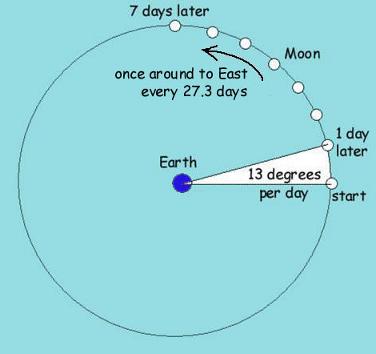
Now, 27 stars * 4 padas = 108 pada / padams divided by 9 planets= 12 Rasi. The first 3 stars in our system are Ashwini, Bharani and Kirtika 1st padam (total: 4+4+1 = 9 padams) into one zodiac sign (Rasi) called Aries.
Ashwini - 4 pada - 13º 20'
Bharani - 4 pada - 13º 20'
Kirtika - 1 pada - 3º 20'
------------------------------------------------------
Total - 9 Pada - 30º --> One Rasi / Zodiac occupies 30 degrees, 30*12 = 360 degrees. Hence, Moon takes 27.3 days to complete one rotation around Earth, but due to earth's rotation around the sun, moon takes 2 more days to patch up with the starting point in it's orbit. For each day when the moon rotates, its position changes with stars, the change in position is 13º 20'. In India, we don't have fixed dates for festivals, we celebrate festival in accordance with stars and solar months. That is the reason why stars, moon dates (Tithi) plays important role in finding dates for festivals, special occasions etc.
Bharani Deepam
Karthigai Deepam is preceded by Bharani Deepam. When Bharani Nakshthra appears in the sky, a small ghee diya will be lighted inside the main deity of Lord Shiva temple, using this ghee diya 5 big lamps will be lighted which represents five aspects of Lord Shiva (five natural elements). People go to Lord Shiva's temple and lit diyas.
Karthigai Deepam day
Karthigai Deepam is preceded by Bharani Deepam. When Bharani Nakshthra appears in the sky, a small ghee diya will be lighted inside the main deity of Lord Shiva temple, using this ghee diya 5 big lamps will be lighted which represents five aspects of Lord Shiva (five natural elements). People go to Lord Shiva's temple and lit diyas.
Karthigai Deepam day
Pooja Procedure at home
Before pooja, we clean the swami room, neatly wipe the gods photos, idols and wash the pooja utensils. After wiping the pooja room shelf / slab, rangoli with rice flour will be drawn and will apply turmeric, kum kum on gods photos and arrange it back to the shelf. Also, will draw rangoli using rice flour in front of the house main door, will beautify the main door by placing flowers / garlands and also will apply turmeric and Kum Kum dots on the sides of the main door. As per tradition, only after watching Thiruvannamalai Deepam on the Arunachala Hills in the evening, we light diyas at home.

On Karthigai Deepam day, as per my family tradition, we do pooja in the morning. But, in my mother's place we do pooja in the evening, it depends upon one's family tradition. Elderly women in our house will place Lord Shiva's photo and Lord Murugan's photo on a pooja stand, then decorate the god's photo with flower garlands and place diyas on two sides of the palagai manai (small low height stool used to sit during pooja). Also will keep new earthenware diyas in front of the pooja stand. We prepare neivedhyam (food offered to god) for pooja, the neivedhyam / Prasadhams are explained below.
In the decorated pooja room, will place the prepared prasadhams in front of god, along with a tray of fruits, betel leaves, betel nuts and a coconut. In a separate tray will place Maa vilkau (Sweet made out of rice flour) at the center and fill it with ghee with a cotton wick to lit. At the time of pooja, we lit maa vilaku, light Dashagam (scented cones), agarbathis (scented sticks) and take aaradhana with agarbathis. Then, break a coconut into 2 pieces and keep it back in the prasasham tray. As per my family tradition, we do pooja in the morning.

Say it loudly
'Annamalaiyaruku Arogara, Annamalaiyaruku Arogara, Annamalaiyaruku Arogara',
'Thennatudaya Shivanea potri, en natavarkum iraiva potri potri',
then sing any Lord Shiva's songs, Lord Murugan's songs (Kandha Shasti Kavasam)
In the evening, after watching Thiruvannamalai Deepam, we watch it in live a program, then light diya in pooja room first and then start lighting the lamps everywhere in the house. The entire house will be filled with brightness of oil earthenware diyaas, also place diyas on the rangoli.

Prasasham preparations
Pori urundai, nel pori urundai, sweet appam and maa vilaku.
Maa vilaku:
It is one of the important mandatory sweet for this festival. Maa - rice flour, vilaku - lamp, a lamp made out of rice flour. Placing this maa vilaku during pooja and lighting fire on this maa vilaku using ghee is considered as auspicous and brings prosperity to the house.

Maa vilaku preparation:
Mix fine rice flour, powdered jaggery, cardamon powder with little bit of ghee. Mix all these ingredients thoroughly with bare hand. Jaggery will start to melt due to hand's heat and start to combine with the mixture. No need to add water for this, if you add water shelf life of Maa vilaku will be less, traditionally will use only ghee as a binding agent. After forming it as dough, shape like a diya and pour ghee and then place cotton wicks.
Pori Urundai :


Kuppa Karthigai (Third Day of the festival)
On this day we place diyas in washrooms, near Garbage area and utility areas. The vapor from the oil diyas kill bacterias due to the moist formed in this winter season.
Some of the pictures of Karthigai Deepam at my house


- Aarthi Thiyagarajan
Before pooja, we clean the swami room, neatly wipe the gods photos, idols and wash the pooja utensils. After wiping the pooja room shelf / slab, rangoli with rice flour will be drawn and will apply turmeric, kum kum on gods photos and arrange it back to the shelf. Also, will draw rangoli using rice flour in front of the house main door, will beautify the main door by placing flowers / garlands and also will apply turmeric and Kum Kum dots on the sides of the main door. As per tradition, only after watching Thiruvannamalai Deepam on the Arunachala Hills in the evening, we light diyas at home.
Rangoli near the main door, picture taken after Maha Deepam Darshan.
On Karthigai Deepam day, as per my family tradition, we do pooja in the morning. But, in my mother's place we do pooja in the evening, it depends upon one's family tradition. Elderly women in our house will place Lord Shiva's photo and Lord Murugan's photo on a pooja stand, then decorate the god's photo with flower garlands and place diyas on two sides of the palagai manai (small low height stool used to sit during pooja). Also will keep new earthenware diyas in front of the pooja stand. We prepare neivedhyam (food offered to god) for pooja, the neivedhyam / Prasadhams are explained below.
In the decorated pooja room, will place the prepared prasadhams in front of god, along with a tray of fruits, betel leaves, betel nuts and a coconut. In a separate tray will place Maa vilkau (Sweet made out of rice flour) at the center and fill it with ghee with a cotton wick to lit. At the time of pooja, we lit maa vilaku, light Dashagam (scented cones), agarbathis (scented sticks) and take aaradhana with agarbathis. Then, break a coconut into 2 pieces and keep it back in the prasasham tray. As per my family tradition, we do pooja in the morning.
'Annamalaiyaruku Arogara, Annamalaiyaruku Arogara, Annamalaiyaruku Arogara',
'Thennatudaya Shivanea potri, en natavarkum iraiva potri potri',
then sing any Lord Shiva's songs, Lord Murugan's songs (Kandha Shasti Kavasam)
In the evening, after watching Thiruvannamalai Deepam, we watch it in live a program, then light diya in pooja room first and then start lighting the lamps everywhere in the house. The entire house will be filled with brightness of oil earthenware diyaas, also place diyas on the rangoli.
Prasasham preparations
Pori urundai, nel pori urundai, sweet appam and maa vilaku.
Maa vilaku:
It is one of the important mandatory sweet for this festival. Maa - rice flour, vilaku - lamp, a lamp made out of rice flour. Placing this maa vilaku during pooja and lighting fire on this maa vilaku using ghee is considered as auspicous and brings prosperity to the house.
Maa vilaku preparation:
Mix fine rice flour, powdered jaggery, cardamon powder with little bit of ghee. Mix all these ingredients thoroughly with bare hand. Jaggery will start to melt due to hand's heat and start to combine with the mixture. No need to add water for this, if you add water shelf life of Maa vilaku will be less, traditionally will use only ghee as a binding agent. After forming it as dough, shape like a diya and pour ghee and then place cotton wicks.
Pori Urundai :
Sweet Appam:
Kuppa Karthigai (Third Day of the festival)
On this day we place diyas in washrooms, near Garbage area and utility areas. The vapor from the oil diyas kill bacterias due to the moist formed in this winter season.
Some of the pictures of Karthigai Deepam at my house
- Aarthi Thiyagarajan


